
One request doesn’t always tell the whole story
In real-world service environments, a single customer issue often has many moving parts. A product defect might generate dozens of incoming requests from different customers. A cross-team task might need to be broken into sub-requests and assigned to multiple departments. A major incident might give rise to a problem, which in turn triggers several change requests.
With Request Relations, SuperOffice Service now makes it easy to relate requests together, visualize how they relate, and manage them as a connected whole, without ever losing the thread.
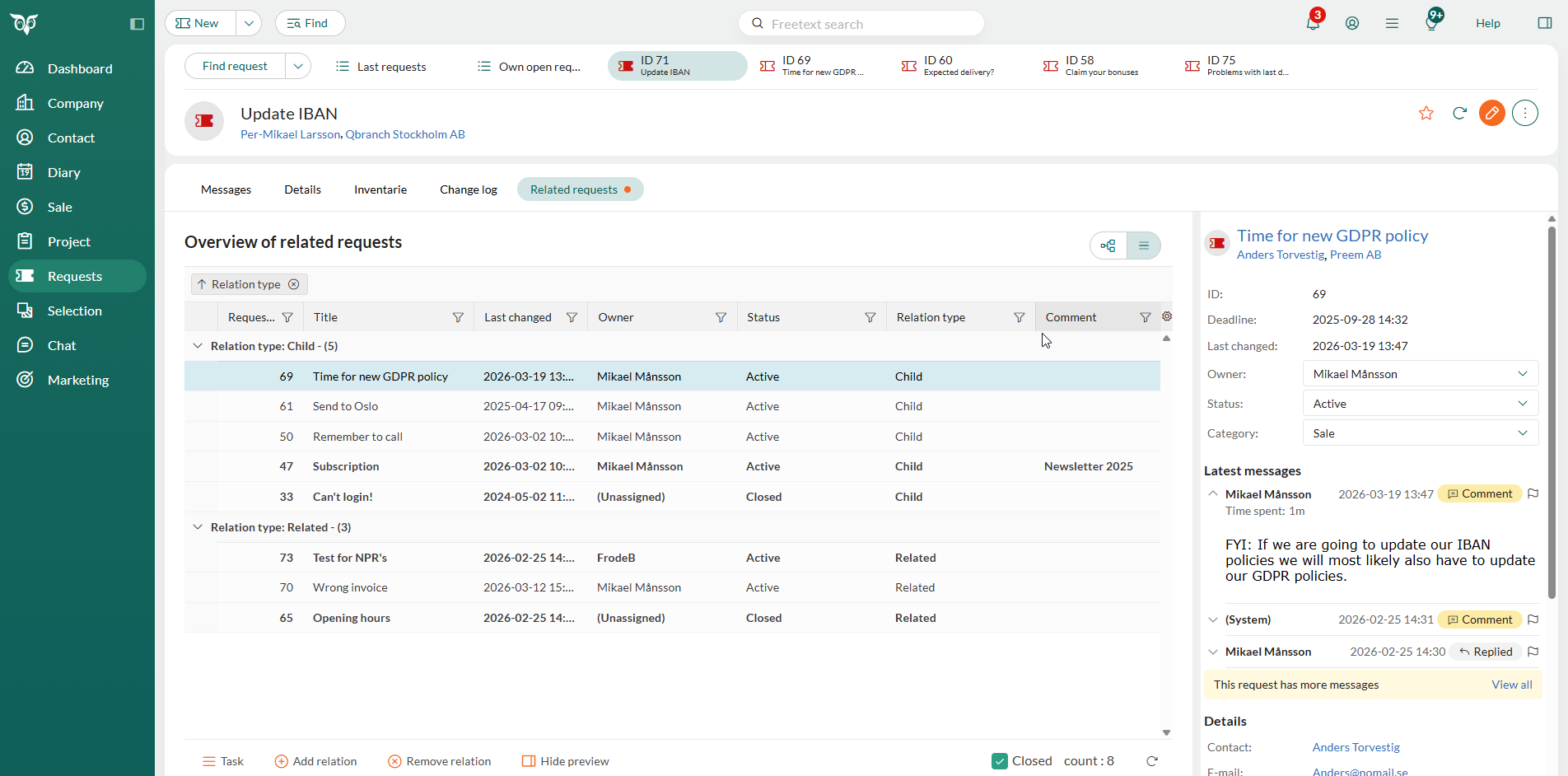
A smarter way to handle complex requests
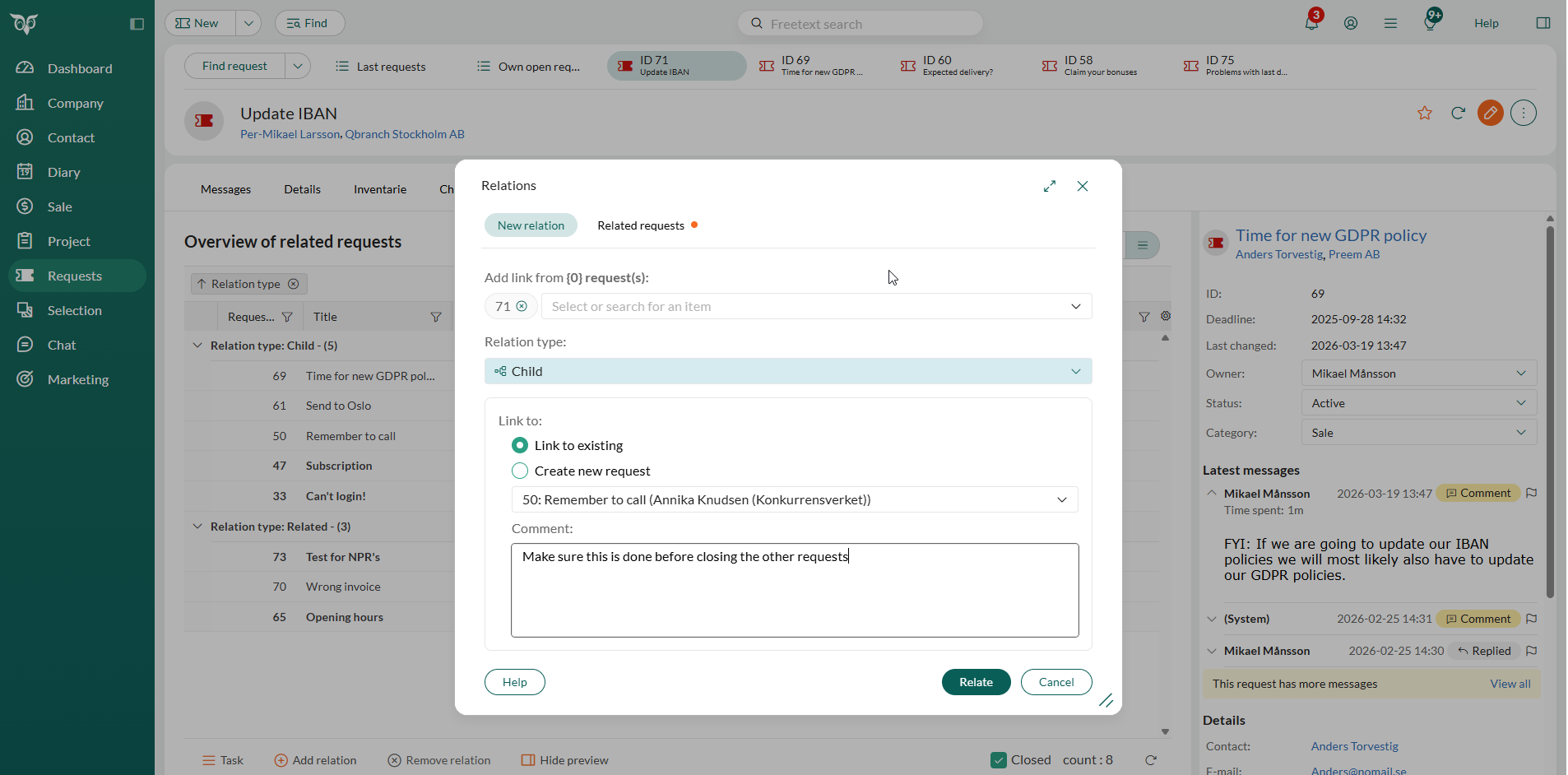
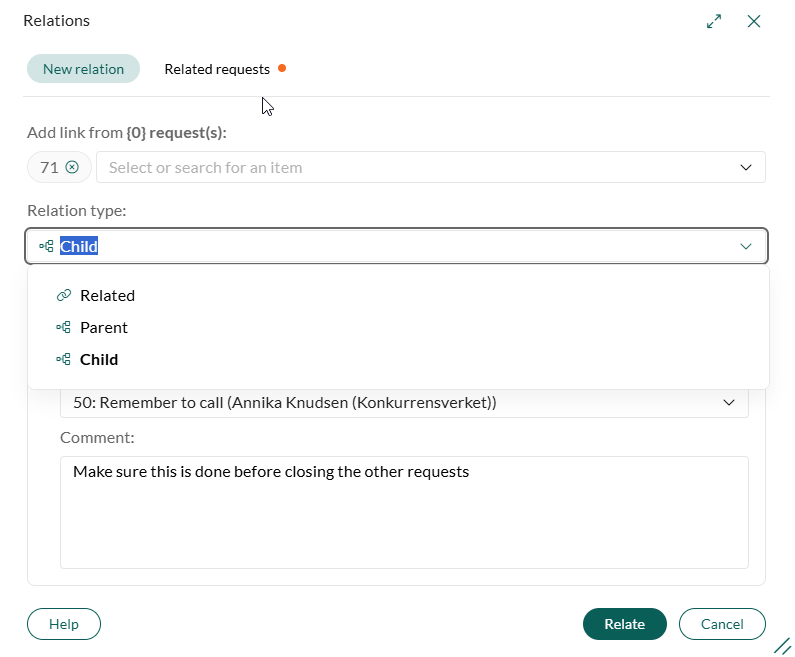
Request Relations lets you link any two or more requests using a defined relation type. Three standard relation types are built in from the start:
- Parent: a request that oversees one or more child requests
- Child: a sub-request that belongs to a parent
- Related: a peer request linked for context or coordination
Get the full story at a glance
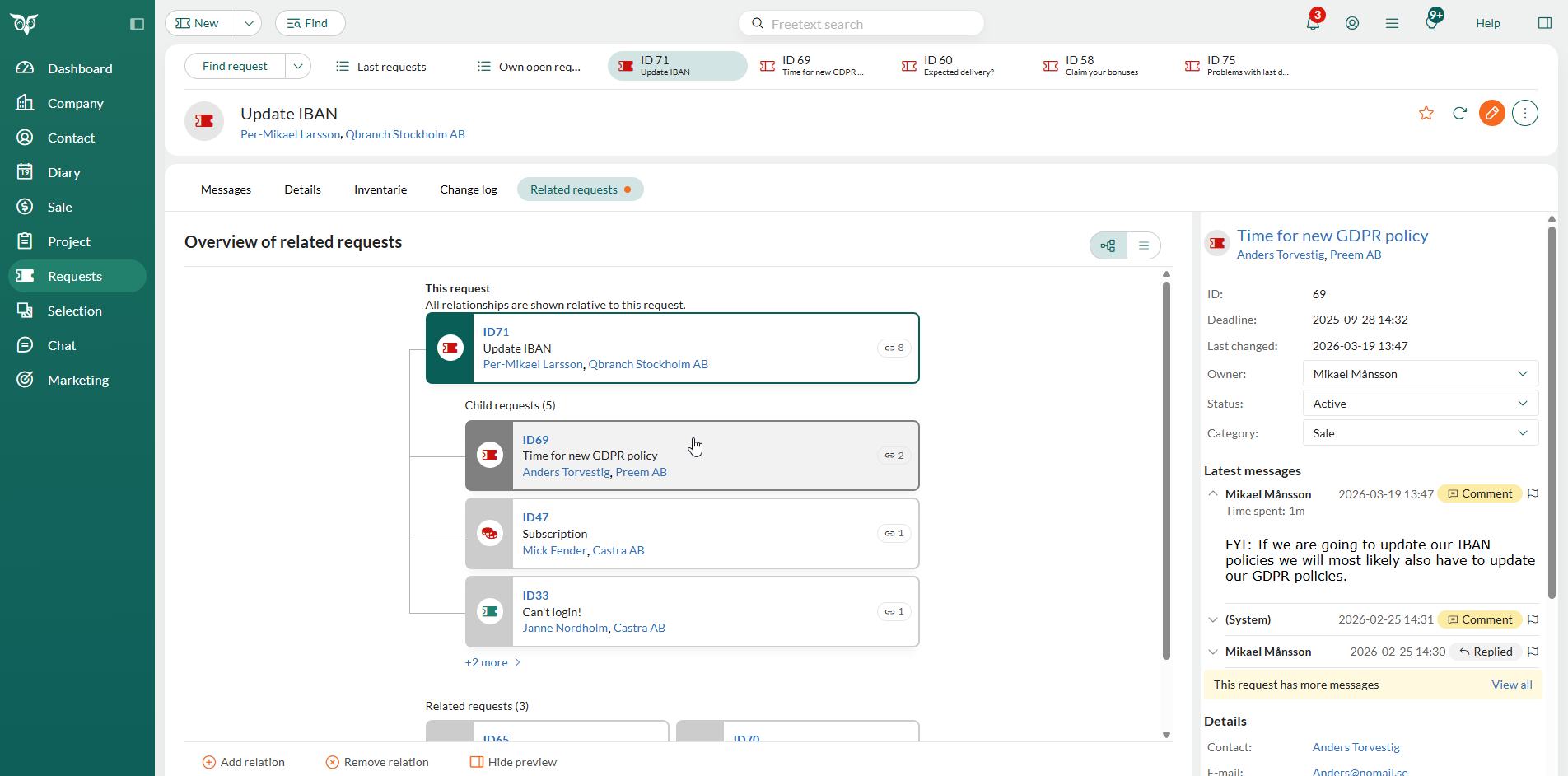
A dedicated Related requests tab on every request gives agents a clear view of how their request fits into the bigger picture. The current request is highlighted so you always know exactly where you are in the hierarchy. You can:
- Toggle between a graphical hierarchy view and a list view
- Click a related request to preview it in a side panel without leaving the page
- Click on the related Request ID to navigate directly to a related request
Built-in rules that keep your team aligned
Administrators can configure smart rules to enforce consistency and guide agents through the right steps. For any relation type, you can activate:
- Mandatory parent on creation: prevent requests of a specific type from being saved unless they are linked to a parent.
- Auto-close parent: prompt agents to close the parent request when all child requests are resolved.
- Block parent closure: prevent closing a parent request while child requests remain open.
- Offer to close all children: when closing a parent, prompt agents to close all related open child requests at once.
The value
By connecting related requests, teams can avoid duplicated work, gain clearer ownership and visibility, and resolve issues faster with all context in one place - freeing up more time for customers instead of chasing scattered tickets.
This means:
- Less duplicated work across teams handling related issues
- Clearer ownership and progress tracking across linked requests
- Faster resolution by keeping all related context in one place
- More time for your customers, less time navigating disconnected tickets
Who is this for?
Request Relations is designed for service teams that deal with multi-step, multi-team, or high-volume scenarios, such as:
- Cross-functional teams that split a single customer request into parallel work items across departments
- Support teams handling the same issue reported by multiple customers, who want to track and respond to all of them together
- Project-oriented teams breaking large initiatives down into stories and sub-tasks within the service module
- IT and operations teams linking incidents to problems and change requests